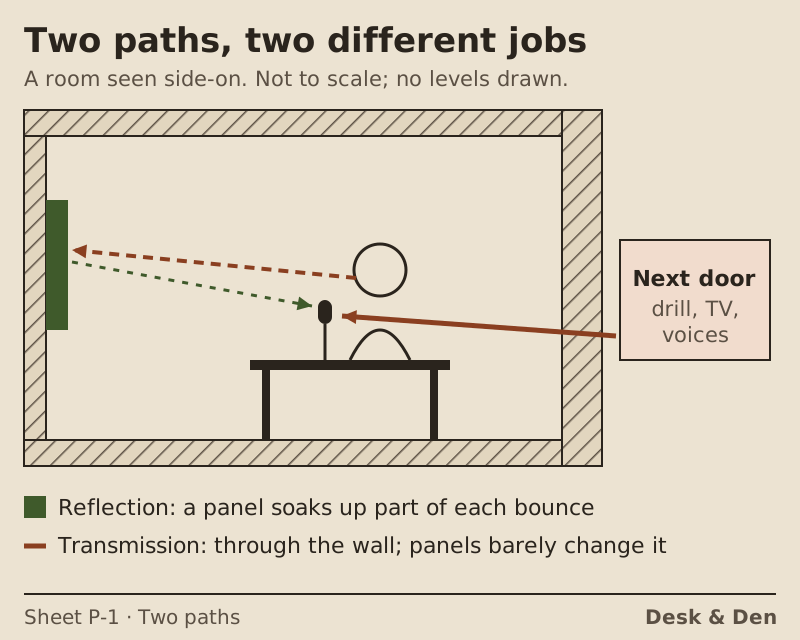
Acoustic panels reduce echo, not noise from outside. They soak up some of the sound bouncing around inside your room, so your own voice reaches the microphone with less of the hollow, bathroom quality that callers notice. They do very little about the drill next door, the traffic outside or the television through the wall, because that sound is travelling through the building, and a soft panel screwed to the inside of a wall barely changes how much gets through. If your callers complain that you sound echoey, panels are a reasonable buy. If they complain that they can hear your neighbour, spend the money elsewhere.
That is the short version for anyone working from a spare room or a corner of the living room. It is not a guide to studio design or home cinema. Everything below sticks to the physics that published sources agree on, with no product claims and no made-up measurements.
Absorption and isolation are two different jobs
Sellers use "soundproofing" loosely, which is where most of the disappointment starts. Acousticians split the subject into two separate jobs with separate ratings. Armstrong, a ceiling manufacturer, puts it plainly on its acoustics page: Noise Reduction Coefficient (NRC) rates a material's sound absorption inside a room, while Sound Transmission Class (STC, for walls and partitions) and Ceiling Attenuation Class (CAC) rate how well a construction blocks airborne sound passing between spaces.
- Absorption changes what happens to sound already inside your room. A soft, porous surface turns some of the energy that hits it into a tiny amount of heat instead of throwing it back. Less comes back, so the room rings less.
- Isolation changes how much sound crosses a boundary: a wall, a floor, a door, a window. It depends on the barrier itself and on the gaps around it, not on what is hung on its surface.
The ratings do not swap. The Wikipedia entry on Sound Transmission Class, which cites the ASTM standards behind it, notes that absorptive interior surface treatments "do not significantly improve" a partition's STC. In plain terms: a wall that lets the neighbour's music through will still let it through with panels on it. Your side of the wall will just sound less reverberant while it does.
What panels do for your voice on calls
Here is where panels earn their keep. A microphone in a bare room hears two versions of you: the direct sound from your mouth, and a cloud of late copies coming off the walls, the window, the desk and the ceiling. The further the mic sits from you, the larger that cloud is compared with the direct sound, and the more hollow you sound to everyone else. Panels shrink the cloud.
Published absorption tables show why soft material matters. HyperPhysics, the physics reference run by Georgia State University, prints coefficients from Hall's acoustics textbook, where 0 means a surface reflects everything and 1 means it absorbs everything. At 1,000 Hz, in the middle of the speech range, rigidly mounted acoustic tile is listed at 0.8. Half-inch gypsum wallboard on studs, the plasterboard most home offices are built from, is listed at 0.04. Medium velour drapery comes in at 0.7. Ordinary window glass sits at 0.1. Swapping a bare stretch of plasterboard for an absorptive surface at the right spot makes a real difference to how much of your voice comes back.
Placement matters more than quantity. The reflections that do the most damage are the early ones, from the surfaces nearest you and your mic: the wall behind your screen, the wall behind your chair, and the desk itself. A couple of panels on those spots will do more for a call than a dozen scattered around the room. Our sheet on why your room echoes walks through finding them with a clap, and the mic placement guide covers the fix that costs nothing at all: putting the mic closer.
Panels are not the only absorbers
You may already own good ones. Thick curtains, an upholstered chair, a full bookcase and a rug all absorb or break up reflections, and the HyperPhysics table gives upholstered seating 0.7 at 1,000 Hz, the same as the drapery. A purpose-made panel is tidier and easier to place exactly where a reflection lands, which is its main advantage over a sofa.
What blocks outside noise, and why it costs more
Blocking sound is a construction problem. Sound gets from next door into your room by shaking the wall, floor or door, and by squeezing through every gap around them. The parts that do the blocking are the heavy, airtight ones: the wall itself, a solid door, double glazing, and the seals around all of them. That is why the work tends to cost more and involve more disruption than hanging panels, and why renters rarely get far with it.
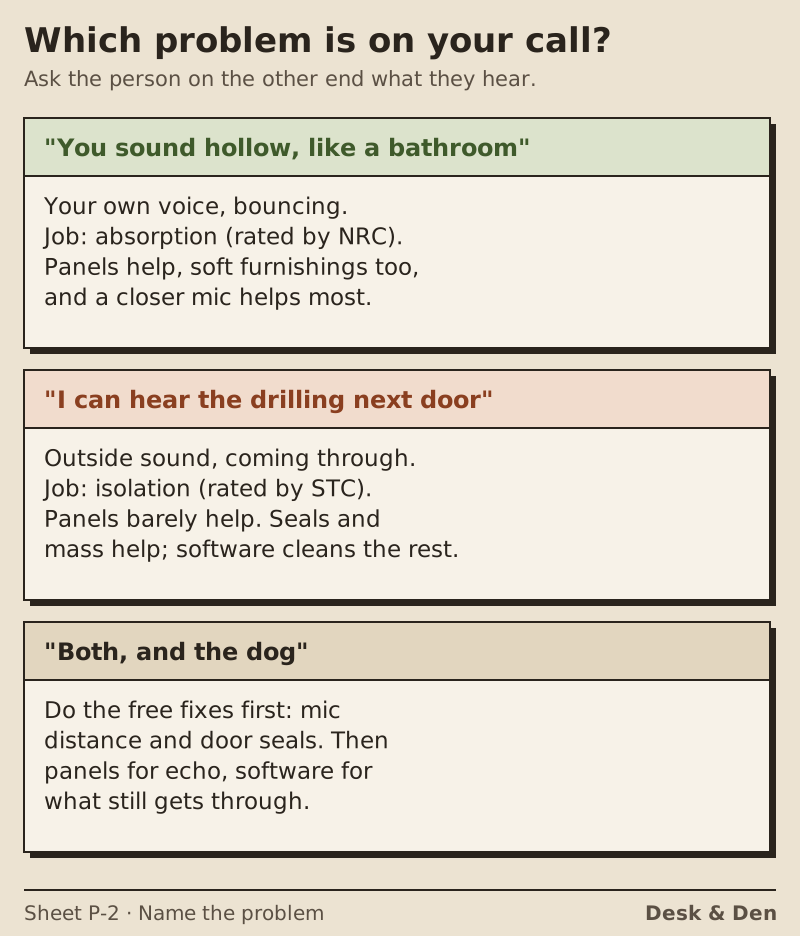
There are still cheaper moves that target transmission rather than echo. Gaps leak sound easily, so sealing the door frame and the gap under the door is usually the most effective low-cost step. Heavy curtains over a street-facing window add a little mass where glass is thin. Our budget soundproofing sheet ranks those by effort, and the household noise survival notes cover the sources inside your own home that no seal will fix.
Do acoustic panels keep sound in?
This is the same question from the other side, and the answer is the same: not meaningfully. If you worry about your calls disturbing the rest of the house, panels will make your room less reverberant, but the wall and the door still decide how much leaks. Close the door, seal its gaps, and keep your voice at a normal level by using a closer mic instead of talking over a distant one.
The software layer, for noise you cannot block
Once the echo is under control and the door is sealed, what is left is usually noise you cannot do anything about: building work, traffic, someone else's meeting in the next room. That is the job noise-suppression software is built for, and on a call it works on the signal rather than on the room.
- Built into your call app. Zoom's desktop app offers background noise suppression at Auto, Low, Medium and High, and Zoom describes High as its most aggressive level, the one aimed at background speech from other people. In the new Teams on desktop, noise suppression is one on/off switch rather than a choice of levels. Google Meet has its own noise cancellation on eligible accounts.
- Built into your computer. Windows 11 ships Voice Clarity switched on, and Microsoft says it needs nothing beyond an x64 or Arm64 processor; it works in apps that use the system's communications mode, unless the PC maker's own audio driver already does that processing. On a Mac running macOS 27, FaceTime and other apps with Mic Mode support put Voice Isolation under the Video item in the menu bar.
- A separate app. Krisp sits between your microphone and every call app as a virtual device and processes audio on your own machine. Its noise cancellation covers your outgoing audio and what you hear from others, and its Voice Isolation targets nearby background voices. It supports macOS 14 Sonoma and later, plus Windows 10 and 11 in their 64-bit versions.
Krisp is the one that costs money. It gives you seven days with no card; after that, nothing works until you subscribe. Core is $8 per user each month when paid yearly or $16 when paid month by month; Advanced is $15 yearly or $30 monthly. Those are the figures on Krisp's pricing page on 9 October 2026. The honest order is still room first, software second, and our page on software versus room treatment explains why the two work better together than either does alone.
Edge cases
Thin foam squares
The cheap, thin foam sold by the dozen is often too thin to absorb much at the lower end of the voice. If the choice is between a few dense panels in the right places and a wall of thin squares, the few panels usually win. A loaded bookcase may beat both.
Low rumble from traffic or a boiler
Deep, low sound is the hardest kind to deal with using anything thin or light, and a typical panel does little for it. A closer mic and a noise-suppression filter are the realistic tools.
Echo that follows you onto headphones
If callers hear their own voice coming back, that is not your room. It is usually your speakers feeding your microphone, and wearing headphones fixes it. Our piece on headphones that prevent echo on Zoom covers the details.
A rented room
Freestanding panels on stands, curtains on a tension rod and a rug all come with you when you move. Fixing panels to a wall you do not own is rarely worth the deposit risk when furniture can do a similar job.
Asked at the bench
Do acoustic panels reduce noise from outside?
Not in any meaningful way. They absorb sound inside your room. Noise from outside comes through the wall, door and window, and absorptive treatments do not significantly raise a wall's sound transmission rating. Seals and mass block noise; panels tame echo.
Are acoustic panels good for a home office?
Yes, if your problem is echo. A few panels on the walls nearest you and your microphone cut the reflections that make you sound hollow on calls. Moving the mic closer is free and should come first.
What is the difference between acoustic panels and soundproofing?
Acoustic panels absorb sound inside a room, rated by NRC. Soundproofing blocks sound passing between rooms, rated by STC for walls. One improves how your room sounds; the other decides how much of next door reaches you.
Do acoustic panels keep sound in a room?
Barely. They lower the echo inside, but the walls, door and gaps decide how much escapes. Close and seal the door, and use a closer mic so you can speak at a normal level.
How many acoustic panels do I need for calls?
Fewer than sellers suggest. Start with the wall behind your screen and the wall behind your chair, then listen again. Placement at the first reflection points matters more than covering a whole wall.