Rooms, mics & call-ready home offices
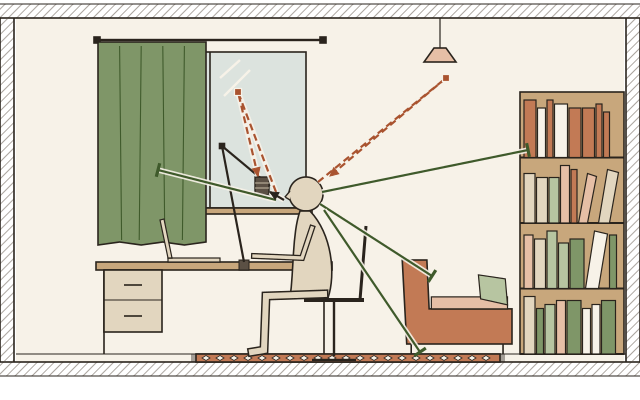
- Bare glass reflects
- Bare wall reflects
- Curtain drawn over the glass absorbs
- A full bookshelf absorbs, and scatters the rest
- Soft chair and cushions absorbs
- Rug on the hard floor absorbs
- Mic a hand-span from your mouth costs nothing
Reflects: comes back to the mic lateAbsorbs: ends in something softCosts nothing
A home office drawn side-on. Hard, flat surfaces send your voice back to the mic late; soft, irregular things the house already owns soak it up; and pulling the mic closer costs nothing at all.
This workshop covers the layer under every meeting app: the room, the microphone, and the habits that decide how you sound before software gets a vote. Everything here is app-agnostic and verifiable with a voice memo — physics doesn't care which client you launch. Settings-level fixes for specific apps live on other sites; the den is about the den.
Where does it hurt?
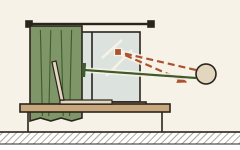 My voice sounds hollow
Reflection, ratio, and the cheap fixes ranked by physics.
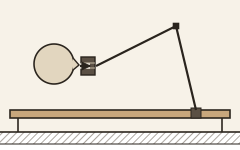 The room's louder than me
Distance, angle, gain — the three dials that beat filters.
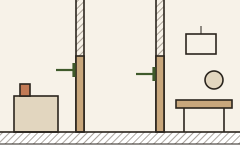 The house won't cooperate
You can't soundproof a family; you can out-system it.
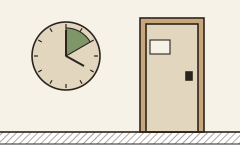 Just make calls not embarrassing
Sixty seconds, five gates, most disasters prevented.
The room
- Why Your Room Echoes on Calls — and the Cheap Fixes That WorkHard parallel surfaces keep sound bouncing; mics drink it in.
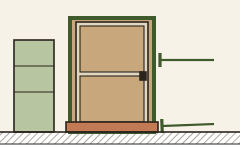 Soundproofing on a Budget: What Works and What's Wasted MoneyBlocking outside noise is mass and seals, not foam.
- Household Noise Survival: Calls From a Full HouseYou can't soundproof a family.
The gear
- Mic Placement That Kills Background NoiseDistance, angle and gain — the three placement decisions that beat any filter.
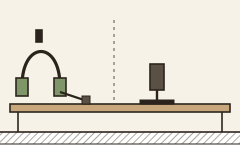 Headset vs Desk Mic: The Real DecisionHeadsets win calls; desk mics win comfort and recordings.
The habits
- The 60-Second Pre-Call ChecklistDoor, devices, mic distance, test loop, mute state — the sixty-second sweep that prevents ninety percent of call embarrassments.
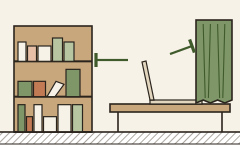 Fix the Room or Buy Software? The Honest OrderPhysics first, software after: which noise problems the room solves, which only software touches, and the decision tree that stops you buying the wrong layer.
And the software question, answered honestly
Physics first — always — but two noise classes genuinely belong to software: unpredictable household life, and noise arriving from your callers. The workshop's assessment of that layer, who needs it and who should keep their money: Software vs room treatment.
About this workshop: an ex-audio-hobbyist's bench applied to work calls; every claim testable by your own ears in a day. How we work →