Soundproof curtains work as echo control and barely work as soundproofing. A thick, heavy curtain over a window soaks up a good share of the mid and high frequencies bouncing around your room, so your voice reaches the microphone sounding less hollow. What it does not do is stop much sound coming in from outside, especially the low rumble of traffic, buses and building plant. Fabric is light and porous, and blocking sound takes weight and an airtight seal. So if callers say you sound like you are in a bathroom, a curtain over the window is a sensible, cheap fix. If they say they can hear the road, the curtain is the last thing to buy, not the first.
This bench note is for a working room at home: a desk by a window, a mic, and a neighbourhood that does not go quiet at nine. The numbers below come from published tables, not from our own measurements, and each one says where it came from.
Why the word "soundproof" oversells a curtain
A curtain can do two things to sound, and they are not the same job. It can absorb sound that is already inside the room, taking some energy out of each reflection. Or it can act as a barrier, reducing what passes through from outside. Product listings tend to blur the two, then show a quiet bedroom.
Absorption is where fabric is genuinely good. Isolation is where it struggles, because a barrier works mainly through mass and through being sealed at its edges. Wikipedia's soundproofing entry puts the curtain problem in one line: the main limit is the lack of a seal at the edge, which hook-and-loop strips, adhesive or magnets can partly fix. It also notes that some curtains use honeycomb air chambers to improve damping. Neither feature turns a curtain into a wall.
What the absorption numbers show
HyperPhysics, Georgia State University's physics reference, reproduces a table of absorption coefficients from Hall's acoustics textbook. A coefficient of 1 means a surface absorbs everything that hits it; 0 means it reflects everything. Medium velour drapery, the closest thing in the table to a heavy curtain, behaves very differently across the frequency range.
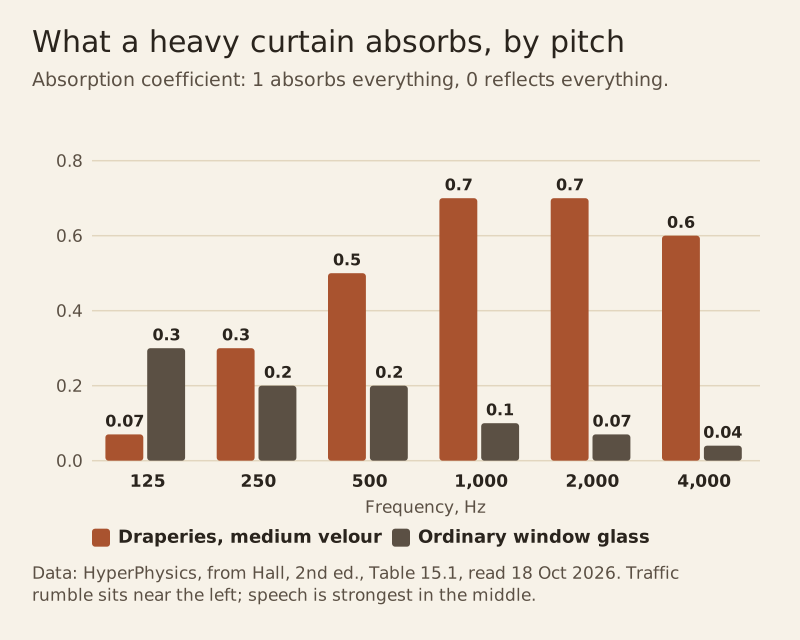
Read the drapery row left to right. At 125 Hz, deep in traffic-rumble territory, it absorbs 0.07, almost nothing. By 1,000 and 2,000 Hz, the middle of speech, it reaches 0.7. Bare window glass runs the other way: 0.1 at 1,000 Hz and 0.07 at 2,000 Hz, so a pane in front of you hands most of your voice straight back toward the mic. Covering that pane with heavy fabric swaps a reflector for an absorber exactly in the range that makes a call sound roomy.
That is the honest case for curtains in a home office. They are a speech-range absorber, and windows are usually the largest hard surface near a desk.
Why gaps undo most of the blocking
Now the other job. Even a heavy barrier loses most of its value through gaps, and a curtain is mostly gap: a rail at the top, an open hem at the bottom, and loose sides. The Sound Transmission Class article on Wikipedia prints a worked example for a partition that could stop up to 40 dB on its own. Open a small fraction of it and the figure collapses.
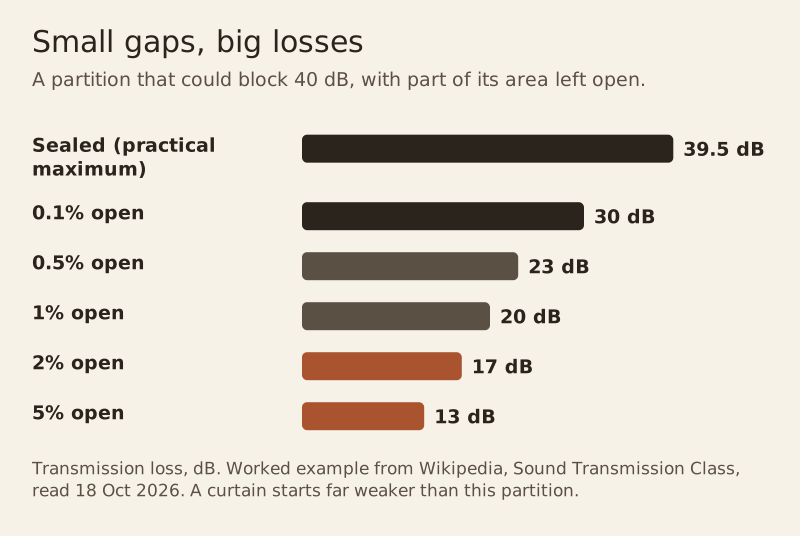
One percent open takes a 40 dB barrier down to 20 dB. Five percent leaves 13 dB. A curtain hanging in front of a window with a hand's width of air around it is well past those percentages, which is why the edges matter more than the fabric weight printed on the packet.
For context on the window itself, the same article lists a typical single pane at STC 27 and dual-pane windows in a range of 26 to 32, and the Wikipedia soundproofing entry adds that standard thermal double glazing often handles low-frequency traffic noise poorly. The weakest part of most home-office walls is the glass and its frame, and a curtain adds a light, leaky layer in front of it.
Hanging one so it actually helps
If the goal is a less echoey voice, placement matters more than price. If the goal is shaving a little off outside noise, sealing matters more than thickness. A few rules cover both.
- Cover the glass completely, with fabric wider than the frame on both sides and longer than the sill.
- Close the edges. Hook-and-loop strips or magnets along the sides cut the gaps that let sound past.
- Use a rail that returns to the wall, so the top edge is not an open slot.
- Go heavy and dense rather than pleated and airy; the absorption numbers above are for velour, not voile.
- Close the curtain for calls. An open curtain bunched to one side absorbs a strip of wall, not the window.
None of this changes the physics of mass. It just stops you losing the small gains a curtain can give. For the noise that still gets in, the cheapest real improvement is usually sealing the window frame itself, which our budget soundproofing sheet covers along with the door.
Curtains against each kind of call noise
Most call complaints fall into a handful of patterns, and the curtain's usefulness changes completely between them.
Your voice sounds hollow or distant
This is where a curtain earns its place. Close it over the window you face or the one behind you, then move the mic closer, which costs nothing and helps more than any fabric. Our mic placement guide has the distances.
Voices, dogs and leaf blowers outside
These sit higher in frequency than traffic rumble. A sealed, heavy curtain over a closed window may take the edge off them, but it will not remove them. Closing the window does more.
Traffic and bus rumble
Low frequencies pass through fabric almost untouched. Better window seals, a secondary glazing insert or a different room are the physical options; noise suppression software handles the steady part of it on the microphone side.
Noise from the next room
Curtains do nothing for sound coming through an internal wall or door. Look at the door seal, then at the furniture against the shared wall.
Edge cases
Rented rooms
A tension rod or a freestanding rail and a curtain leave with you and need no holes. Hook-and-loop at the edges can go on the rail and the curtain rather than the window frame.
"Thermal" and "blackout" labels
These describe heat and light. Some listings add a noise claim alongside them; treat it as a claim about absorption at best, and test it against your own call recording.
Windows you need to open
An open window is a hole, and no curtain behind it makes up for that. Close it for calls and air the room between them.
Questions we get
Do soundproof curtains really work?
Partly. They absorb echo inside the room well in the speech range, so your voice sounds closer on calls. They block very little outside noise, especially low traffic rumble, and any gap at the edges takes away much of what blocking they do offer.
Do noise reducing curtains block traffic noise?
Not much. Published absorption figures for heavy velour drop to 0.07 at 125 Hz, where traffic rumble lives, and blocking it needs mass and seals. Window seals or a secondary glazing insert do more.
Will curtains reduce echo on Zoom or Teams calls?
Yes, if they cover a hard surface near your desk, usually a window. Heavy drapery absorbs about 0.7 of the sound hitting it at 1,000 to 2,000 Hz, the core of speech, where bare glass absorbs 0.1 or less.
Are thicker curtains better for noise?
Heavier, denser fabric absorbs more and adds a little mass, but sealing the edges matters more than thickness. A thick curtain with open sides still leaks around itself.
What works better than soundproof curtains for a home office?
For echo, moving the mic closer and adding soft surfaces. For outside noise, sealing the window and door gaps first, then glazing upgrades. For whatever remains, noise suppression on the microphone handles steady sounds the room cannot.